.png)
REDUCED FERTILITY + BIOLOGY = Highest Average Yield
Rosana Farms, a Saskatchewan grower put that question to the test on commercial acres of lentils. MNP led the third-party agronomy and data collection. AdvancedAg supplied the biological program.


Could We Take 30% Out of the Fertility Program and Still Protect Crop Performance?
The full design compared the grower standard with AdvancedAg programs at 100%, 90%, 80% and 70% of the farms standard. That fertility ladder let the trial ask more than whether biology “worked”: it tested how crop performance changed as conventional fertility was deliberately stepped down.
Rosana Farm’s 65 lb/ac fertility program was the grower-standard benchmark on these acres. The lowest AdvancedAg treatment used 45.5 lb/ac — 30% less. No conventional fungicide was applied to these lentils; SRP was used as the foliar plant-health treatment.
CUTTING FERTILITY DID NOT CUT ESTABLISHMENT
MNP collected tissue across hill, mid-slope and depression positions on June 24. AGVISE reported the results July 12. This was the first point in the season where the nutrient-efficiency story became difficult to ignore.

The 80% fertility program produced the strongest average tissue response overall: +24.0% N and +31.3% P versus the untreated grower-standard comparison. At 30% less fertility, tissue N and P were higher than the untreated grower- standard comparison at every matched landscape position sampled.
The June tissue results were already in hand. The July 14 visit was not about finding the best-looking strip for a photograph. It was about seeing whether the crop in front of us was consistent with what the data were already showing.
MNP continued following the treatments through the season with crop measurements and repeated imagery. By pod set on July 28, plant height remained tightly grouped: 41.9 cm at 70% fertility versus 43.5 cm in the grower-standard comparison.
The Lowest Fertility Rate Finished With the Highest
AdvancedAg Average Yield.

The 70% fertility treatment averaged 42.88 bu/ac across its two harvested strips (44.81 and 40.96 bu/ac). AdvancedAg at the full grower-standard fertility rate averaged 39.56 bu/ac. The harvested grower-standard comparison strip yielded 36.98 bu/ac.
The key comparison is not simply “less input.” The 70% program used 19.5 lb/ac less fertilizer
than farms grower-standard rate, used no conventional fungicide, and still delivered
the strongest AdvancedAg treatment-average yield.
A SEASON-LONG NUTRIENT EFFICIENCY STORY
One harvest result can get attention. The strength of this trial is that the crop was measured before the combine ever entered the field.

The goal is not to use less for the sake of using less. The goal is to make more from every acre and every unit of fertility.
What this trial does not do is prove that every farm should cut fertility by 30%. It shows why fertility efficiency deserves to be tested with measurement — and why the answer should come from the crop, the data and the combine.
Before automatically repeating the same fertility program next season, there is value in
asking a better question: what can we measure, what can we improve, and where can
biology help conventional fertility work harder?
MEASURING THE ROI BENEFITS
The overall return after program expenses was $98.14 greater per acre on the reduction and AAG program versus the control, representing a 17% improvement in net value per acre.
Test it. Measure it. Follow it all the way to Margin.
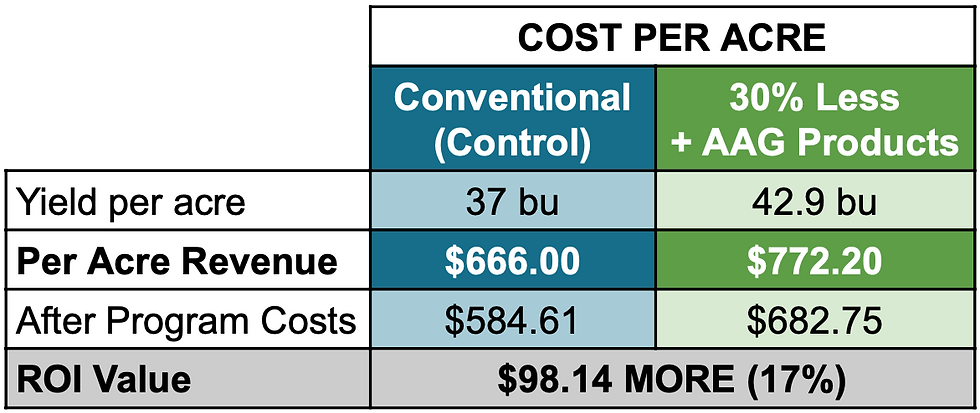
Across the 40 acres, that equates to approximately $3,925 in additional financial return after accounting for program costs.
When viewed at full-farm scale, the economics become even more significant. If a similar per-acre return were achieved across 500 acres, the additional value would be approximately $48,620, increasing to roughly $97,240 across 1,000 acres. While actual farm-level results will vary based on input costs, commodity prices, field conditions, and management practices, the trial highlights the importance of evaluating a fertility program based on total economic return— not simply the upfront cost per acre.

PLANNING YOUR NEXT FERTILITY PROGRAM?

Talk with AdvancedAg about where biology, nutrient efficiency and margin fit on your farm.

$50
Product Title
Product Details goes here with the simple product description and more information can be seen by clicking the see more button. Product Details goes here with the simple product description and more information can be seen by clicking the see more button

$50
Product Title
Product Details goes here with the simple product description and more information can be seen by clicking the see more button. Product Details goes here with the simple product description and more information can be seen by clicking the see more button.
$50
Product Title
Product Details goes here with the simple product description and more information can be seen by clicking the see more button. Product Details goes here with the simple product description and more information can be seen by clicking the see more button.


Comments