.png)
Are We Mining the Soil? Not Exactly.
One of the questions that sometimes comes up when we talk about nutrient cycling is whether we are, in a sense, “mining” the soil. It's a fair question.
After all, if biology is helping make nutrients that are already in the soil more available to the crop, it can sound like we are simply pulling more out of the ground. But that is not really what is happening.
The goal is not to strip nutrients out of the soil and leave less behind. The goal is to improve how efficiently nutrients move through the system, including the nutrients that are already there and the nutrients being added through a normal fertility program.
Unavailable Nutrients in the Soil
A soil test can tell us what nutrients are present, but that does not always mean those nutrients are immediately available to the crop.
Phosphorus is a good example.
A grower may apply phosphorus fertilizer, but over time the majority of that phosphorus becomes tied up in forms that are difficult for the plant to access. The nutrient is still there, but it is not necessarily available when the crop needs it.

The same thing can happen with other nutrients. This is where biology plays an important role.
Bacteria and other microorganisms help break down organic material, cycle nutrients, and convert certain unavailable forms into forms that plants can actually use.
So when we talk about “unlocking” nutrients in the soil, what we are really talking about is improving access.
That Is Different From Mining
True nutrient mining happens when more nutrients are removed from the soil than are being replaced over time. Eventually, that catches up with you. That is not the approach we are talking about.
Growers are still applying fertility. Nutrients are still being added back into the system. The difference is that we are trying to help the biology in the soil make better use of both existing nutrient reserves and newly applied fertilizer.
In other words, this is not about taking from the soil without giving anything back. It is about making the entire fertility program more efficient.
Biology Is Not a Replacement for Chemistry
Our biological products are not designed to replace a grower’s fertility chemistry altogether. Fertilizer still plays an important role in supplying the nutrients a crop needs.
The role of biology is to help make that chemistry work more efficiently.
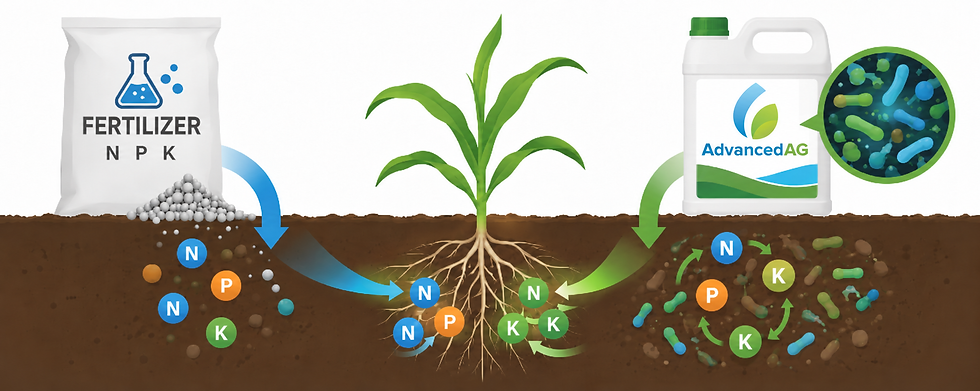
By improving nutrient cycling and helping convert certain unavailable nutrient forms into plant-available forms, soil biology can support better use of both existing soil nutrients and newly applied fertilizer. The objective is not to eliminate chemistry, but to help growers get more value from the fertility they are already putting into the field.
In simple terms, chemistry supplies the nutrients; biology helps improve how effectively those nutrients move through the soil and become available to the crop. This where there is a opportunity for a reduction in conventional inputs.
That is where the opportunity lies: not replacing a proven fertility program, but making it more efficient, more productive, and potentially less wasteful over time.
Better Cycling Means Better Efficiency
When nutrients are cycling more efficiently, there is less reliance on simply adding more product to solve every fertility problem. Instead, the focus becomes getting more value out of the fertility that is already being applied.
That can mean improving nutrient availability, reducing losses, supporting better root access, and potentially allowing growers to reduce certain fertility rates where soil conditions and crop needs support it.
So are we “mining” the soil? Not in the traditional sense.
The key word is efficiency.
We are not trying to grow a crop by draining the soil. We are trying to help the soil function better so nutrients are used more effectively.
Increased Efficiency = Greater Profitability
When biology improves nutrient cycling, the benefit is not limited to unlocking nutrients that are already in the soil. It can also help the entire fertility program work more efficiently.
That means growers are able to rely less on the traditional approach of simply adding more fertilizer whenever crop demand increases or nutrient availability falls short. Instead, biology helps improve how effectively existing soil nutrients and applied fertility are converted, cycled, and made available to the crop.
More importantly, this matters financially.

If the crop can get more value from the fertility already being applied, growers have a better opportunity to control input costs, reduce unnecessary applications, and maintain productivity without relying on ever-increasing fertilizer rates.

$50
Product Title
Product Details goes here with the simple product description and more information can be seen by clicking the see more button. Product Details goes here with the simple product description and more information can be seen by clicking the see more button

$50
Product Title
Product Details goes here with the simple product description and more information can be seen by clicking the see more button. Product Details goes here with the simple product description and more information can be seen by clicking the see more button.
$50
Product Title
Product Details goes here with the simple product description and more information can be seen by clicking the see more button. Product Details goes here with the simple product description and more information can be seen by clicking the see more button.


Comments